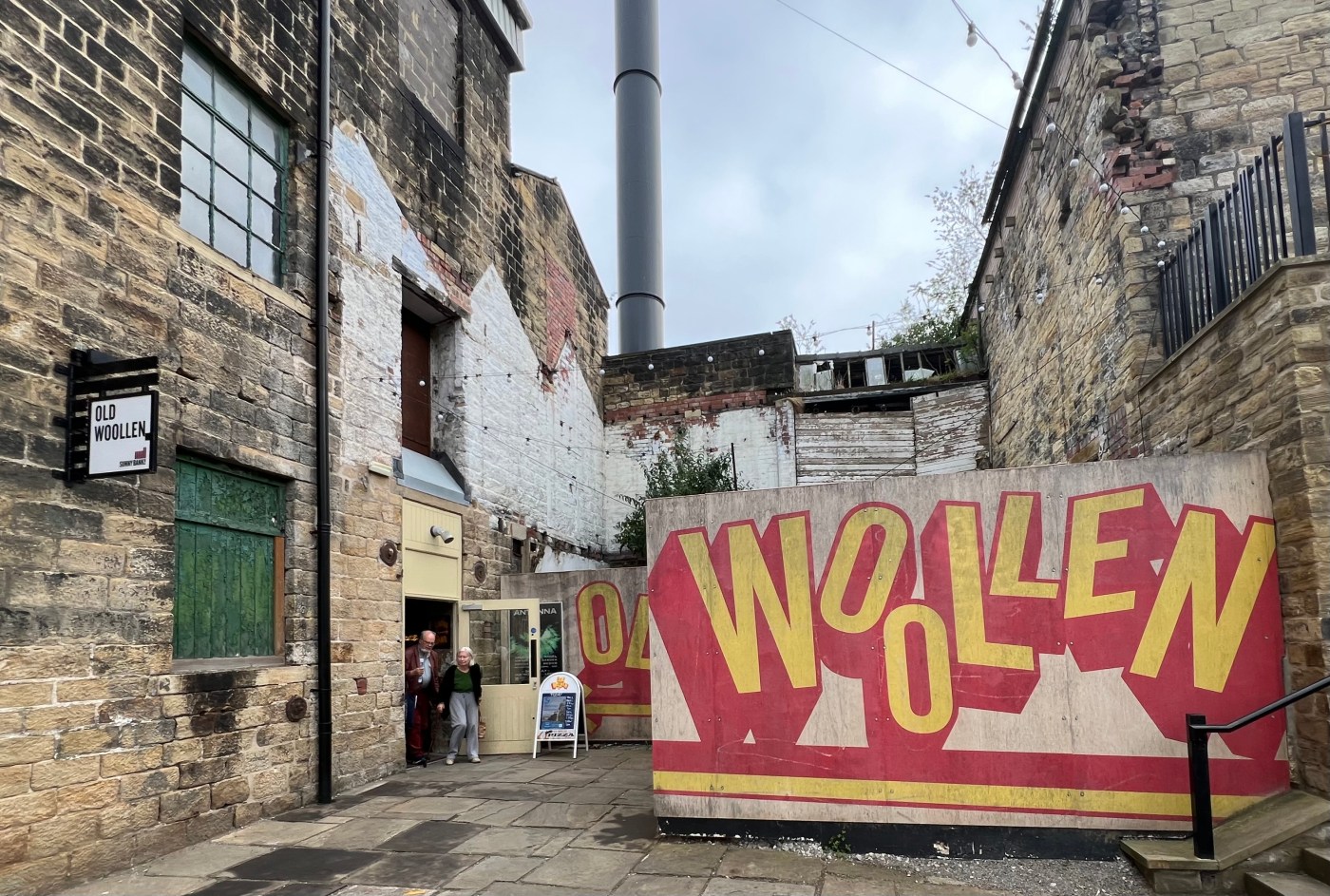
It was interesting to get back to Farsley as, between 1978 and 1982, I lived just around the corner from Sunny Bank Mill when it was still, well, a mill. Like the rest of the area it has now been gentrified – everywhere seems to go upmarket when I leave – and is home to various performance spaces, bars and restaurants, including Old Woollen which is where this concert was being held.
This is the penultimate event in Leeds Baroque Choir & Orchestra’s 25th Anniversary year and was another cracker. The choir had obviously had a day off, as the programme was entirely instrumental, the title is probably a bit of a give away there. Before the main event, there was the usual pre-concert talk, which I always find very interesting and enlightening. Admittedly a lot of it sails above my head at the altitude of a long haul flight, but the bits I do manage to understand make the coming pieces that much more enjoyable, adding a bit of meat to the bare bones of my knowledge.
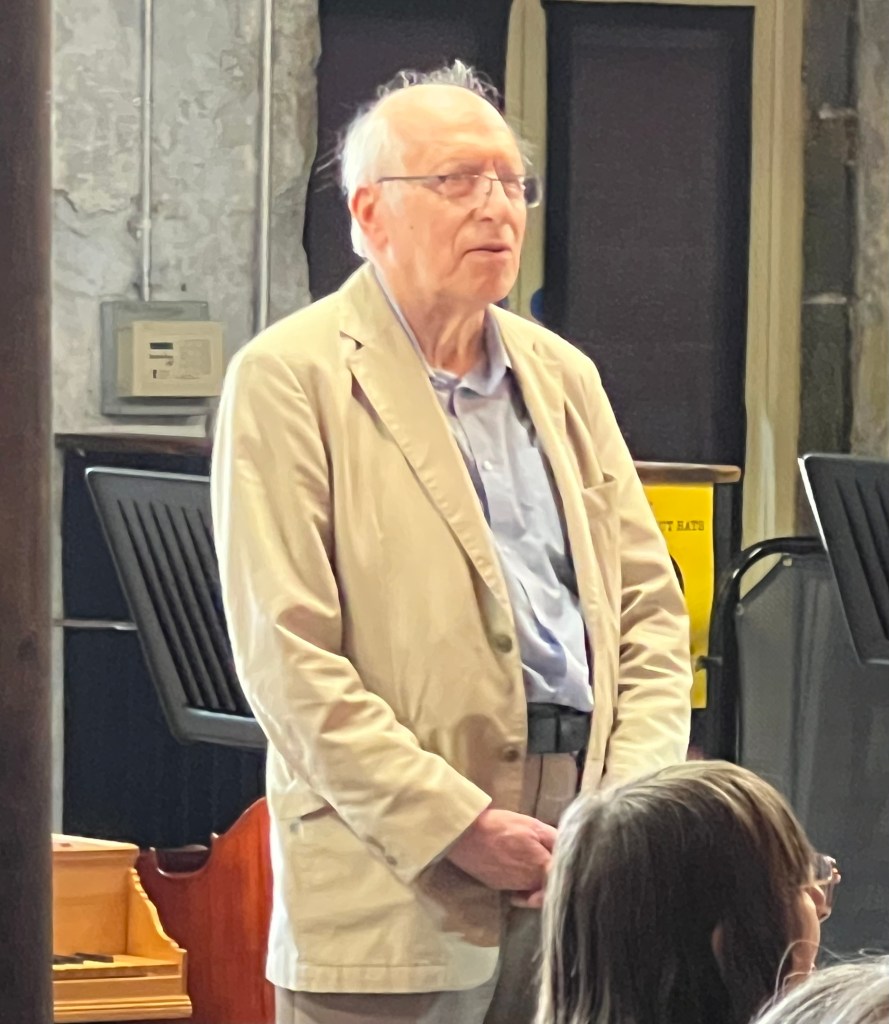
Emeritus Professor Michael Talbot. The Fourmost authority on Vivaldi – a Merseybeat joke there.
Today’s chat was given by Michael Talbot, Emeritus Professor of Music at the University of Liverpool. He is a researcher in the field of of historical musicology, going back even further than Gerry and the Pacemakers, to the period between 1650 and 1750, which is handy really, as that coincides with the Baroque period. What are the chances? He specialises in Vivaldi but is not averse to studying the works of other composers of the time.
I don’t wish to demean the talk by calling it a chat, but it was delivered in a way that even a listener with no technical knowledge could take advantage of. He went through the mini biographies of the composers whose works we were about to hear, whilst telling us that they might not be quite what we thought, as authorship of a lot of music of the time was not always accurate. in fact, it seems that something we think is a very modern practice was rife back in those days. Teaser. There were a couple of works by Tomas Albinoni (1671-1751), four by Antonio Vivaldi (1678-1741), one which was either by Alessandro Marcello (1673-1747) but could have been by his brother, Benedetto (1686-1739) who knows, and one, again by Vivaldi, in conjunction with Anonymous (for some reason there are no dates for this person – just a minute – oh, yes!). It is this last one which brings us up to date, as it is thought, from the style of writing, that anon may have been German (einnon?), but whatever, he is responsible for three-quarters of it, the remaining quarter being a Vivaldi sample! As we don’t know who the culprit was, chunks of the other bits might also have been copied and pasted, using a quill pen of course.
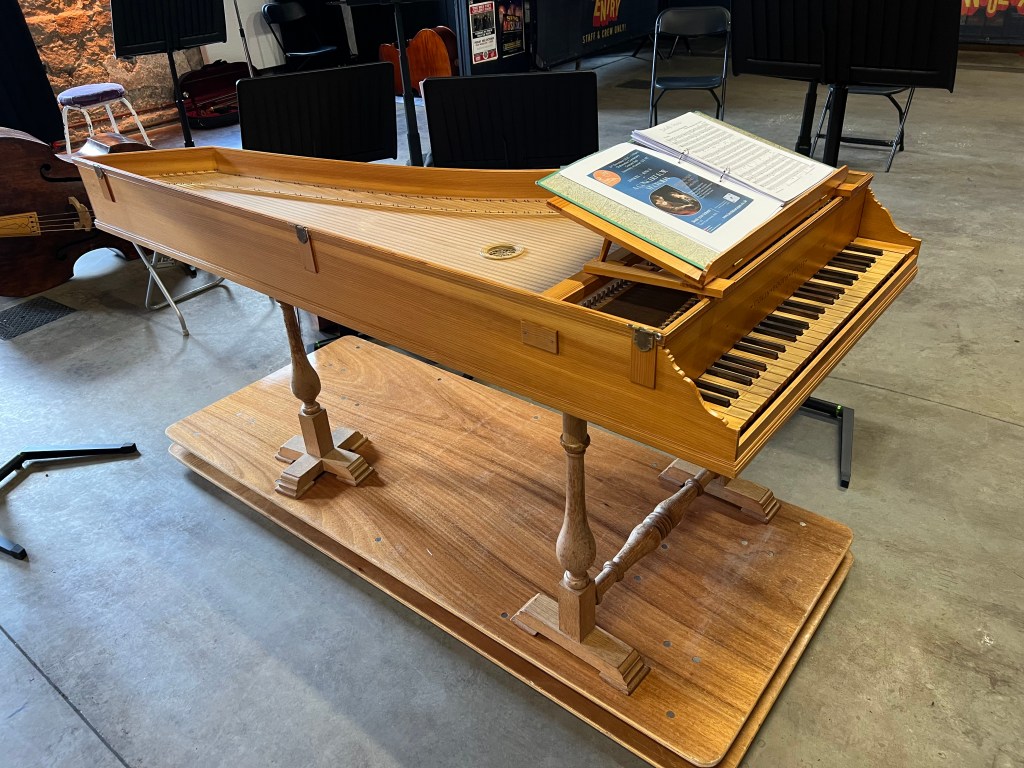
The magnificent harpsichord played by Peter Holman
An interesting snippet about Vivaldi was that he was very ill as a child, probably with infantile paralysis, which made his breathing laboured. This explains why Spring and Autumn in the Four Seasons are written celebrating the best of the temperate months, whilst Summer and Winter concentrate on the worse elements, of baking hot sunshine and freezing temperatures, which made his respiration painful.
The first piece in the concert was Balletto à cinque no.2 in G minor So 3 by Tomas Albinoni which was played by the full orchestra.
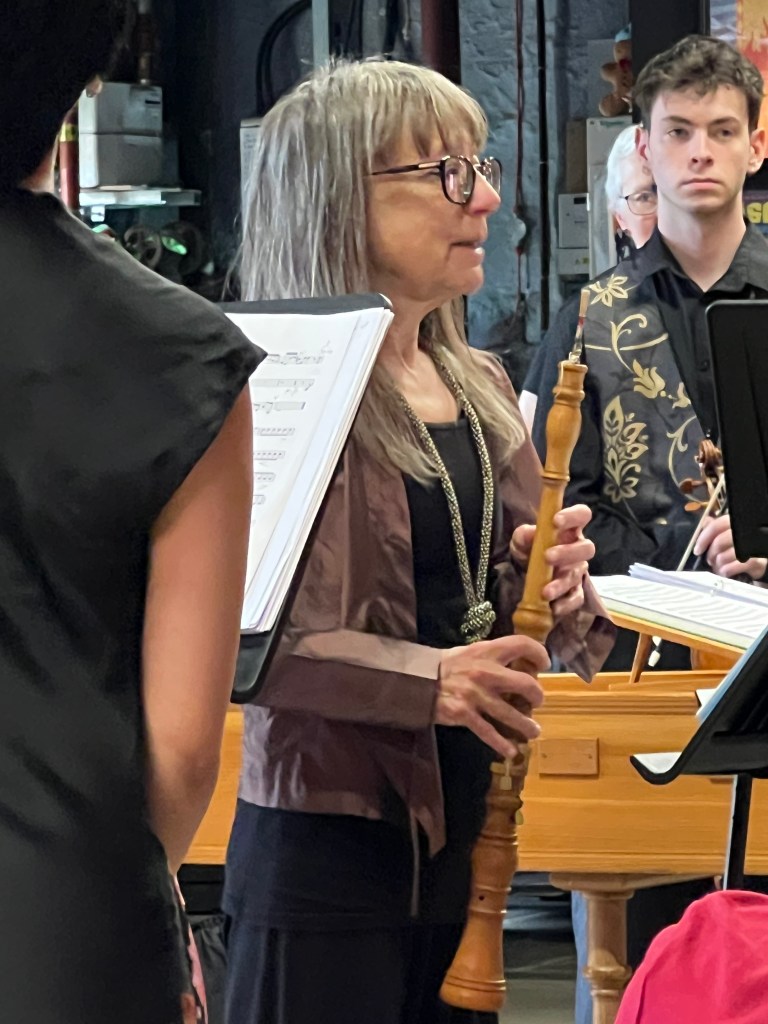
Gail Hennessy with wooden oboe
The second, Concerto in D minor by either Alessandro or Benedetto Marcello, I wonder if they were as volatile as the Gallaghers, featured Gail Hennessy on oboe. Her instrument was made of wood and is a copy of one displayed in Nuremberg. The problem with these is that they can split with age, can’t we all! She dedicated her performance to friend, mentor and inspiration, Martin Stancliffe, who was a master of the oboe, as well as an architect, who died earlier in the year. She certainly did him justice. It seems his brother, who is a bishop, was present in the audience, I think I spotted him moving diagonally towards the bar during the interval.
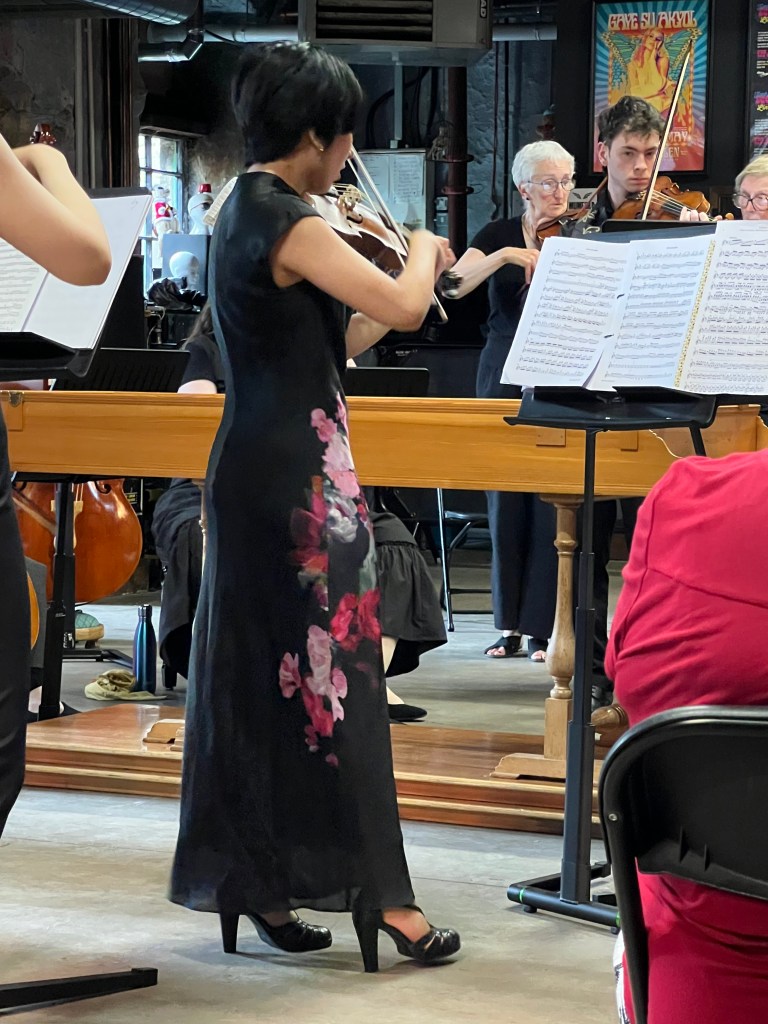
Asuka Sumi setting her violin on fire in Grosso Mogul.
The two pieces before the break were both by Vivaldi; Sinfonia al Santo Sepolcro in B minor RV 169 and, the big closer, Concerto in D major, RV 208 ‘Grosso Mogul’. The latter was a real show-off piece highlighting the amazing skills of soloist: Asuka Sumi, who extracted every ounce of expression from her instrument. The first movement made Orange Blossom Special sound pedestrian, the second was slow, and the third ramped up the tempo again. Fortunately the concert was an informal affair so, when the audience broke into spontaneous applause at the end of movement one, everyone joined in and smiled, rather than shuffled and tutted at the breach of protocol.
If you want to see what a violinist can do, have a look at https://www.youtube.com/watch?v=gs8s_6Ex04Y where a totally different orchestra perform the piece but it is still impressive.
Time for a coffee.
The second half kicked off with another Albinoni, he must specialise in openers, Sinfonia in G minor T Si 7, after which it was back to Vivaldi, and Sonata in C major RV801. This was played by a quartet which included both the previous soloists, along with Catherine Strachan, violoncello and orchestra director, Peter Holman, on harpsichord. I don’t know whether it was the natural volume of the instruments, or their positioning, but the keyboard seemed to be a bit overwhelmed by the strings. It was still an impressive piece though.
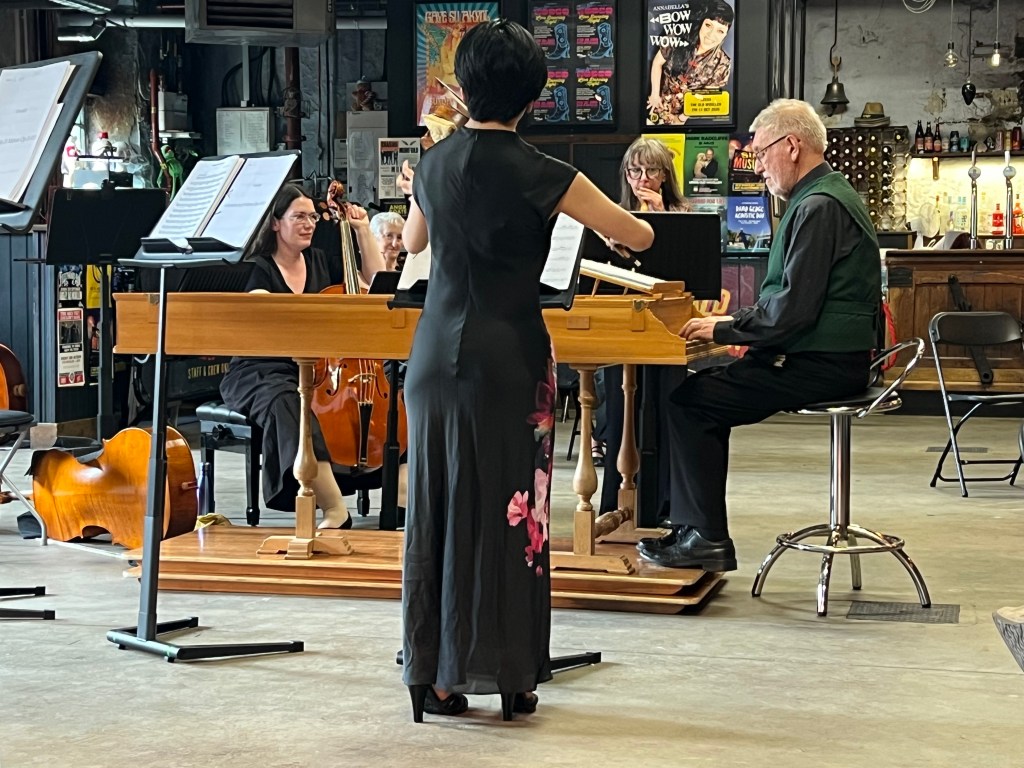
The quartet playing Sonata in C major. Left to right; Catherine Strachan, seated, on violoncello; Asuka Sumo, violin, Gail Hennessy, oboe and Peter Holman, who introduced all the pieces, on harpsichord.
Next cab off the rank was Concerto in D minor RV 565, published as no. 11 in L’Estro armonico, Op. 3 (1711). This had three soloists involved; Manlu Du and Derek Revill, violins and Catherine Strachan, violoncello. I thought this had more than a hint of the Four Seasons about it, but what do I know.
The afternoon ended with the aforementioned piece, by DJ Person or Persons Unknown, who took to the mixing desk and sampled Vivaldi. I also think that they might have spliced in a few bars of Sailor’s Hornpipe as well, for good measure.
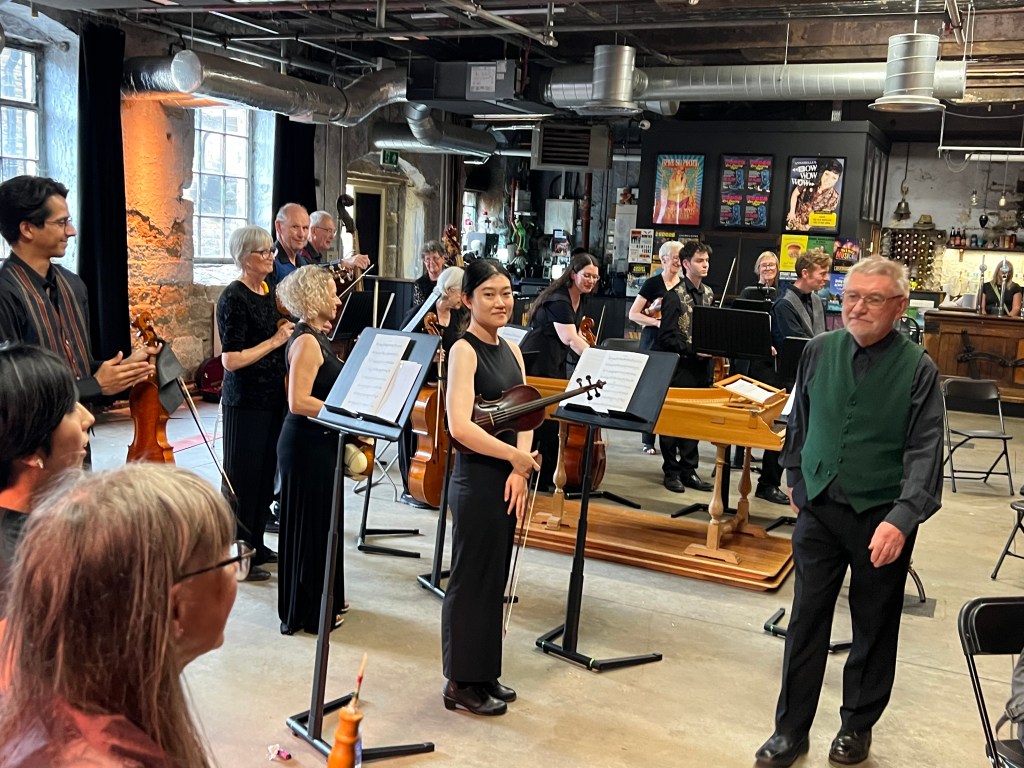
The full ensemble soaking up the well deserved applause.
I really wish I could do the music more justice, but my base line – not bass line – is rooted in the pop music of the late fifties and beyond, which, apart from a few tunes, are not really linked to Baroque, but they should be. Who knows, if a German unknown can sample Vivaldi, why shouldn’t Fatboy Slim slip in some Albinoni? You’re welcome, Norman.
There is one more chance to join Leeds Baroque Choir and Orchestra in this, their 25th Anniversary Year, and that is on 23rd November, 2025 at Clothworker Centenary Concert Hall, University of Leeds. It begins at 3.00pm but I imagine there will be a pre-concert talk to enhance your enjoyment. Judging by the recitals I have attended, your enjoyment won’t need much enhancing.
For more details of the concert and all things Leeds Baroque, please go to https://leedsbaroque.co.uk/
To see what else is coming to Old Woollen – warning, it ain’t Baroque – go to https://oldwoollen.seetickets.com/search/all
All photographs by Stan Graham

